
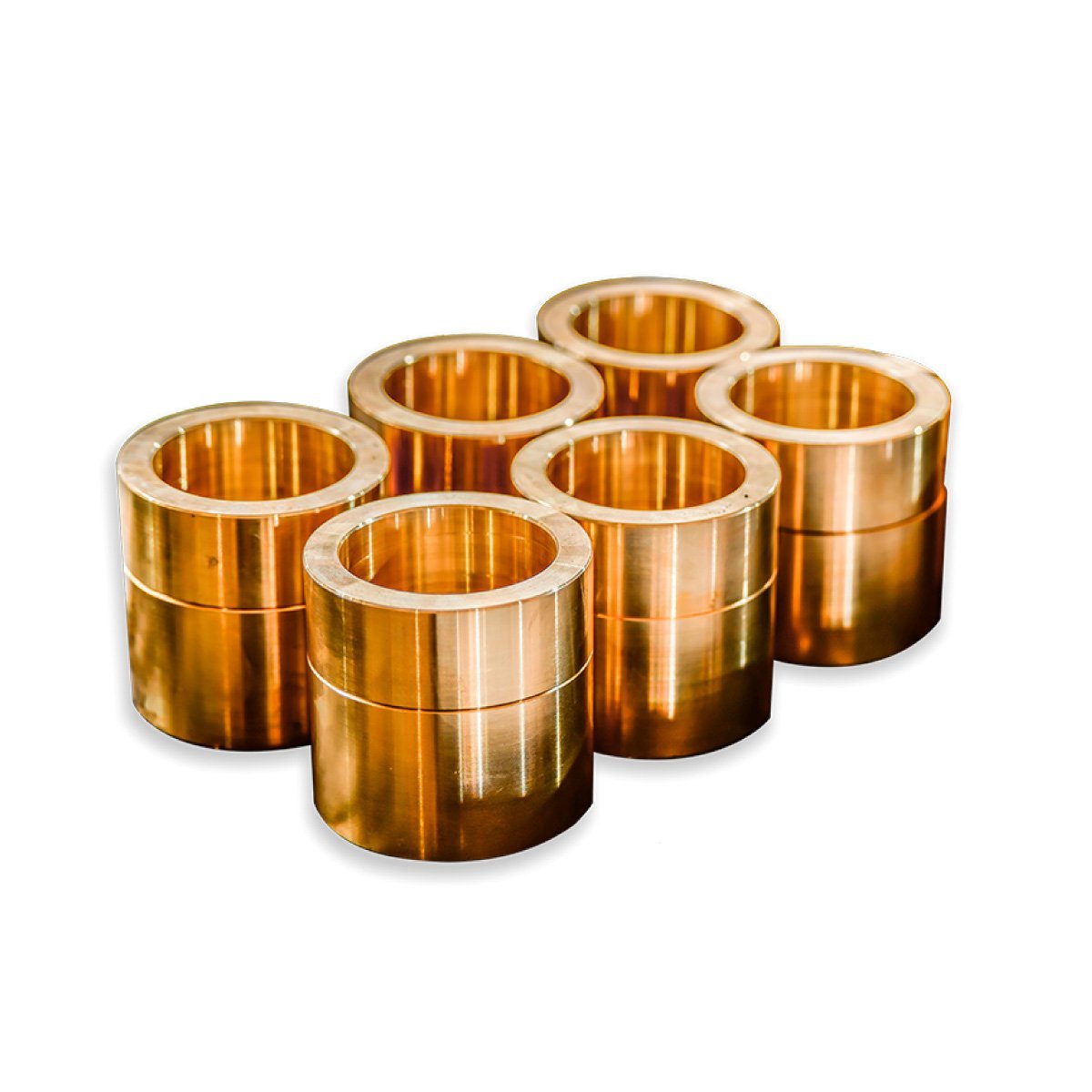
Brass is a copper-based alloy incorporating elements such as zinc, lead, tin, and sulfur. We supply them as standard, or phosphorized (CDA 844), SAE 62 and SAE 64. These alloys are commonly used in wear-resistant parts of moving machinery, acting as joining, clamping, transmission, or sliding elements. The key difference between them lies in their mechanical strength, corrosion resistance, toughness, and ability to withstand wear.
Brass are copper alloys with elements such as zinc, lead, tin, sulfur, and Pb, and are marketed under various names, such as Standard Bronze, Phosphor Bronze (CDA 844), with high Pb and S contents, and the designations SAE 62, with Sn and Zn contents, and SAE 64, with Pb and Sn contents.
These alloys play a crucial role in applications where wear resistance is required, acting as parts, sections or spare parts subject to wear in moving machinery.
They function as joining, transmission fastening or sliding elements in different industrial contexts. The distinction between the three qualities lies in their specific properties. SAE 62 stands out for its good corrosion resistance, medium hardness and ability to resist wear. It is ideal for mechanical elements subjected to high loads and low speeds, such as crowns, worm screws, bushings, and connections for water vapor and gas. On the other hand, SAE 64 is characterized by its excellent machinability and high wear resistance.
Designed for mechanical elements that experience high loads and high speeds, such as pump impellers, bushings and gears, this bronze excels in environments where mechanical strength and durability under demanding conditions is required. The standard or SAE 844, known as phosphor bronze, is recommended for its easy machinability, used for light-duty applications, medium speed mechanisms, such as bushings, bearings.